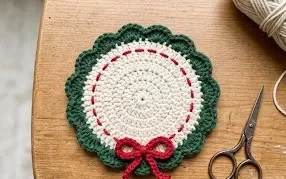
Crochet Wreath Coaster for a Festive Christmas Table
Soft cotton yarn gives this little Christmas wreath coaster a useful, sturdy feel, while green stitches and small red accents bring a familiar holiday touch to the table. It sits beneath a mug of cocoa or tea and adds a handmade detail to a coffee table, desk, or seasonal place setting. The project suits newer crocheters who want to practice even tension, as well as gift makers putting together a few small handmade presents. You’ll work simple crochet stitches into a wreath-shaped piece and add the finishing details that give it a festive look. The compact size makes it satisfying to finish in a short crafting session, and changing the colors lets you make a set that fits your own holiday decor.
Why You’ll Love This Pattern
A firm cotton washcloth is useful at the sink, in the bath, or tucked into a gift basket. This beginner-friendly pattern uses single crochet throughout, so you can focus on keeping the edges straight rather than learning several stitch patterns. The compact rectangle works well with one ball of worsted cotton, and the simple rows are easy to pause and pick up again.
Use it as written for a cloth about 8½ by 7½ inches, or add rows to make it longer. Cotton gives the fabric absorbency and holds up to regular washing. Choose a smooth yarn in a light color if you want to see your stitches clearly while you work.
The rows were easy to count, and the finished cloth feels sturdy without being stiff. I made one in an evening.
— Anna, beginner crocheter
Pattern Overview & Skill Level
- Skill Level: Beginner. You need to chain and make single crochet stitches.
- Approximate Time: About 2–3 hours, depending on your pace and how often you stop to check your edges.
- Construction: Worked flat in back-and-forth rows from one short edge to the other. There is no shaping or seam.
- Finished Dimensions & Sizing: Approximately 8½ inches wide by 7½ inches tall after washing and laying flat. Individual tension and yarn can change the finished size.
Materials & Supplies Needed
- Yarn: About 75–90 yards of worsted-weight (#4) 100% cotton yarn. One color is enough; scraps of similar-weight cotton can also be joined at row ends for stripes.
- Hook: 5.0 mm (US H-8). If your fabric feels too loose, try 4.5 mm; if it feels stiff, try 5.5 mm. Changing hook size can alter the finished dimensions.
- Notions: Tapestry needle for weaving in the starting and finishing tails, scissors, and a ruler or tape measure.
- Substitutions: Choose another smooth, machine-washable cotton yarn of similar thickness. Cotton-linen blends can feel slightly firmer, while bamboo-cotton blends may drape more. Acrylic is less absorbent and may not be as suitable for a washcloth. A different yarn weight changes the cloth size and may require a different hook.
Make a small swatch before beginning if you need a particular size. With the recommended yarn and hook, the target gauge is about 14 single crochet stitches and 16 rows per 4 inches. The exact gauge is less important for a household cloth than a garment, but a dense, flexible fabric will hold up better than one with large gaps.
Stitch Guide & Abbreviations (US Terms)
- ch: Chain.
- sc: Single crochet. Insert the hook into the indicated stitch, yarn over and pull up a loop, then yarn over and pull through both loops.
- st / sts: Stitch / stitches.
- rep: Repeat the stated sequence.
- turn: Rotate the work to begin the next row from the opposite side.
The turning chain does not count as a stitch in this pattern. Work the first single crochet into the first stitch at the base of the chain, not into the turning chain. This keeps the stitch count consistent at 30 stitches per row.
Step-by-Step Pattern Instructions
Washcloth
- Foundation: Ch 31. The chain is the foundation edge and is not included in the row stitch count.
- Row 1: Sc in the second ch from the hook and in each ch across. Turn. (30 sts)
- Rows 2–30: Ch 1, sc in each st across, turn. The ch 1 does not count as a stitch. (30 sts each row)
After Row 30, check that the cloth is close to square and that both sides have 30 stitches. Fasten off, leaving a tail long enough to weave in, usually 5–6 inches. Pull the tail through the final loop to secure it. Thread the tail onto a tapestry needle and weave it through several stitches on the wrong side, changing direction once so it is less likely to work loose. Weave in the starting tail the same way.
There is no required border. For the cleanest edge, keep the first and last stitch of every row easy to see, and avoid accidentally working into the turning chain. If the sides look uneven, count the stitches before continuing; adding or losing one stitch in several rows can make the cloth noticeably wider at one end.
Care & Washing Instructions
- Wash cotton in a machine on a warm cycle, up to about 40°C (104°F), or follow the yarn label if it gives a lower limit.
- Dry flat or tumble dry on low heat; high heat can shrink cotton or make it feel rougher over time.
- While damp, smooth the corners and edges back into a rectangle and let the cloth dry flat. Follow the yarn label for any special blocking instructions.
Pro Tips & Common Mistakes to Avoid
- Keep your starting chain relaxed. A tight foundation can pull the first edge inward; if needed, use a hook one size larger just for the chain, then switch to the listed hook for Row 1.
- Count the stitches at the end of every few rows. Each row should have 30 single crochet stitches, and the turning chain is never counted.
- Weave in the yarn tails on the wrong side, passing the needle through the backs of several stitches and changing direction. Do not pull so firmly that the fabric puckers.
- To make the cloth wider, add chains to the foundation and work one single crochet into each chain after the first. Each extra chain adds about one stitch of width and uses a little more yarn. Add rows for more height; extra rows increase yarn use and finished length.
Frequently Asked Questions
Can I use a different yarn for this washcloth?
Yes. A similar-weight cotton is the closest substitute. A thinner yarn makes a smaller, lighter cloth, while thicker yarn makes a larger, denser one and may need a larger hook. Check the care label before using a blend or synthetic yarn.
How can I make the washcloth larger or smaller?
Change the foundation chain to adjust the width, then add or remove rows to adjust the height. Keep the chain length consistent with the intended width, and count one single crochet in each chain after the first. A different hook or yarn also affects the final measurements.
Is this a good first crochet project?
Yes, if you know how to make a chain and single crochet. The rows repeat without shaping, and the stitch count stays at 30. Beginners may find it helpful to place a marker in the first stitch of each row until the edges become easy to recognize.
Can I sell washcloths made from this pattern?
Check the designer’s terms before selling finished items, and follow any credit or usage requirements. Use your own listing photos and describe the yarn and care instructions accurately.
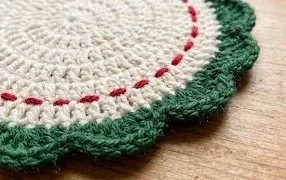
Your finished coaster has a soft, handmade texture and a cheerful wreath shape that’s ready for a holiday mug or a small gift. For a different look, use cream or gold accents instead of red, or make a matching set in several shades of green. If you make one, share a photo on Pinterest or your favorite social media platform; it’s always lovely to see how different yarn choices change the finished piece. When you’re ready for another seasonal project, explore more free crochet patterns on the blog and find a small make to fit your next quiet crafting session.